 BarevTrip
UNESCO sites in Armenia: three monuments and the tentative list
Armenia has three UNESCO World Heritage Sites, all cultural: the monasteries of Haghpat and Sanahin in Lori Province (no. 777; Haghpat inscribed in 1996, Sanahin added in 2000), Geghard Monastery and the Upper Azat Valley in Kotayk Province (no. 960, 2000), and the cathedral and churches of Etchmiadzin together with the ruins of Zvartnots in Armavir Province (no. 1011, 2000). Garni Temple, Noravank, Tatev and the Areni-1 cave are not on the List: they are entries on Armenia’s tentative list, which the country keeps itself. Khor Virap and Sevanavank are not on the List. In the BarevTrip catalog the three sites of the List are three separate trips from Yerevan: Geghard with Garni as a half-day, Etchmiadzin with Zvartnots and Khor Virap, and Haghpat with Sanahin as a full day.
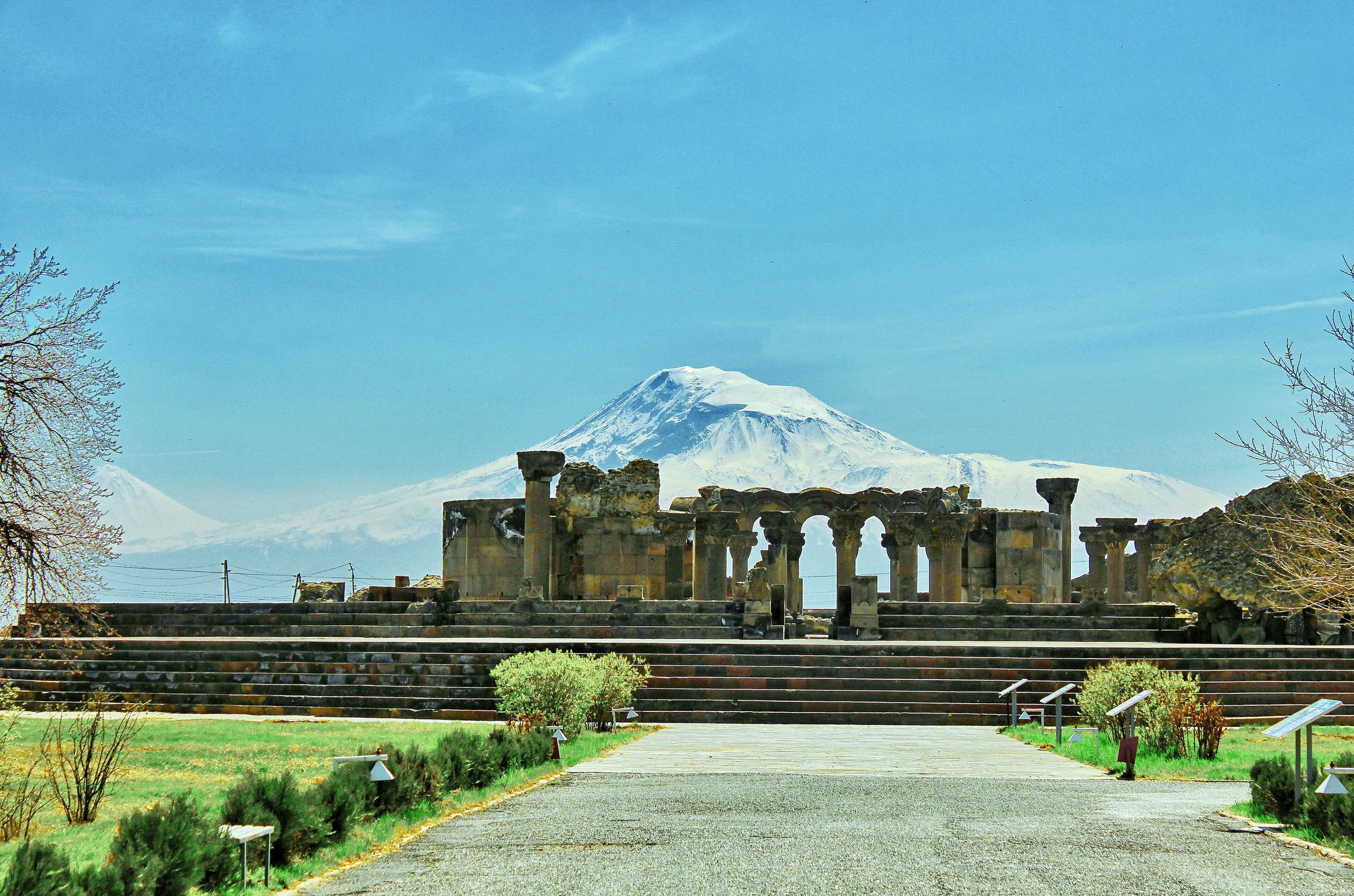 Photo: Beko, CC BY-SA 4.0
Contents
What the UNESCO List and the tentative list are
Sites that have “outstanding universal value” enter the World Heritage List; under the Operational Guidelines this means significance that goes beyond national boundaries (paras 49 and 77). The decision is taken by the World Heritage Committee at its annual session, under one or more of ten criteria. The Armenian sites were inscribed under three: (ii) — “an important interchange of human values” in architecture and art (all three); (iii) — “a unique or at least exceptional testimony to a cultural tradition” (Etchmiadzin and Zvartnots); (iv) — “an outstanding example of a type of building” illustrating a stage in history (Haghpat and Sanahin).
The tentative list is a different document. Under para. 62 of the Guidelines it is an inventory of sites the state itself considers suitable for nomination; without an entry in it a nomination is not considered (para. 63). “On the tentative list” means “the country intends to propose it”, not “UNESCO has recognised it”; the press sometimes writes “approved by UNESCO”; we write “added to the tentative list”.
For your trip this status affects neither admission nor the route; it tells you where UNESCO and ICOMOS have described in detail what to look at.
The three World Heritage Sites
Site (UNESCO database name)
- 777 bis
- Monasteries of Haghpat and Sanahin
- 960
- Monastery of Geghard and the Upper Azat Valley
- 1011
- Cathedral and Churches of Echmiatsin and the Archaeological Site of Zvartnots
Province
- 777 bis
- Lori
- 960
- Kotayk
- 1011
- Armavir
Year
- 777 bis
- 1996, extension 2000
- 960
- 2000
- 1011
- 2000
Criteria
- 777 bis
- (ii)(iv)
- 960
- (ii)
- 1011
- (ii)(iii)
Components
- 777 bis
- Haghpat Monastery, Sanahin Monastery, the Sanahin bridge over the Debed
- 960
- one — the monastery with its gorge
- 1011
- six — the cathedral, Gayane Church, the cemetery, Hripsime and Shoghakat (two sites), Zvartnots
Area
- 777 bis
- 2.65 ha
- 960
- 2.97 ha
- 1011
- 74.3 ha
None of the three is on the “in danger” list. The owner is the Armenian Apostolic Church, except for the Zvartnots site, which is state-owned. In all, the List has more than 1,270 sites. Site pages on the UNESCO website: no. 777, no. 960, no. 1011.
Haghpat and Sanahin. Haghpat was founded, per the UNESCO text, in 976 by Queen Khosrovanush; the main church, Surb Nshan, was completed in 991, and its architect was Trdat. The gavit (narthex) dates from the early 13th century, the bell tower from 1245. At Sanahin the Astvatsatsin church dates from the 930s and Amenaprkich from 957–966; the gavit of Amenaprkich, of 1181, ICOMOS describes as “the earliest known example” of the cross-in-square plan on four columns; more than 50 khachkars survive. The 13th-century bridge over the Debed is a separate component. The Committee inscribed Haghpat in 1996 in Mérida and approved the extension with Sanahin in 2000 in Cairns.
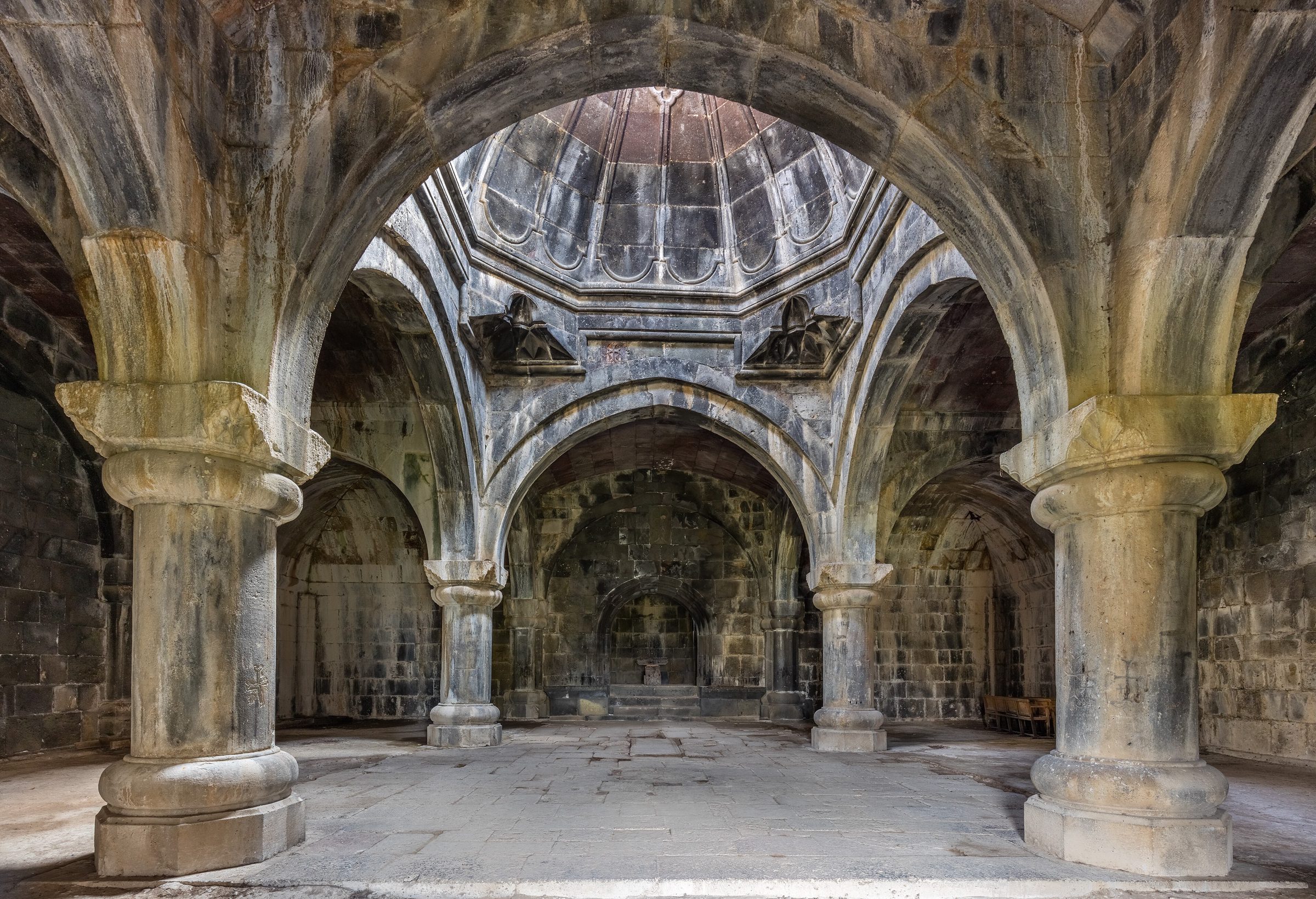 Photo: Diego Delso, CC BY-SA 4.0
Geghard. The main church, Katoghike, dates from 1215 by its inscription, the gavit from about 1225, the rock-cut churches from before 1250 and 1283, and the burial chamber from 1288. The earliest inscriptions are 1177 and 1181, on a chapel outside the walls. The earlier name was Ayrivank, “the monastery in the cave”; the present Geghardavank, “the monastery of the spear”, is found from a document of 1250. Since 7 December 2018 Geghard has been on the International List of Cultural Property under Enhanced Protection under the Second Protocol to the 1954 Hague Convention; it is the only Armenian site there. You will meet the phrase “Garni and Geghard are a UNESCO site”; it is inaccurate: Geghard is no. 960, and Garni is only on the tentative list.

Etchmiadzin and Zvartnots. By tradition the cathedral was built in 301–303 by King Tiridates III and Gregory the Illuminator (see “By tradition”). The present cross-shaped plan is a rebuilding of the 480s, the stone dome dates from the first third of the 7th century, the bell tower from the 1650s, and the paintings by Nagash Hovnatan from the early 18th century. Restoration ran from 2012 to 2024; the cathedral was closed to visitors from 2018 and reopened in September 2024. The Hripsime church dates from 618, Gayane from 630, Shoghakat from 1694. Zvartnots was built under Catholicos Nerses III the Builder and completed around 662; it was destroyed in the 10th century, probably by an earthquake, was uncovered in the early 20th century by Toros Toramanian, and has been a museum-reserve since 1923.
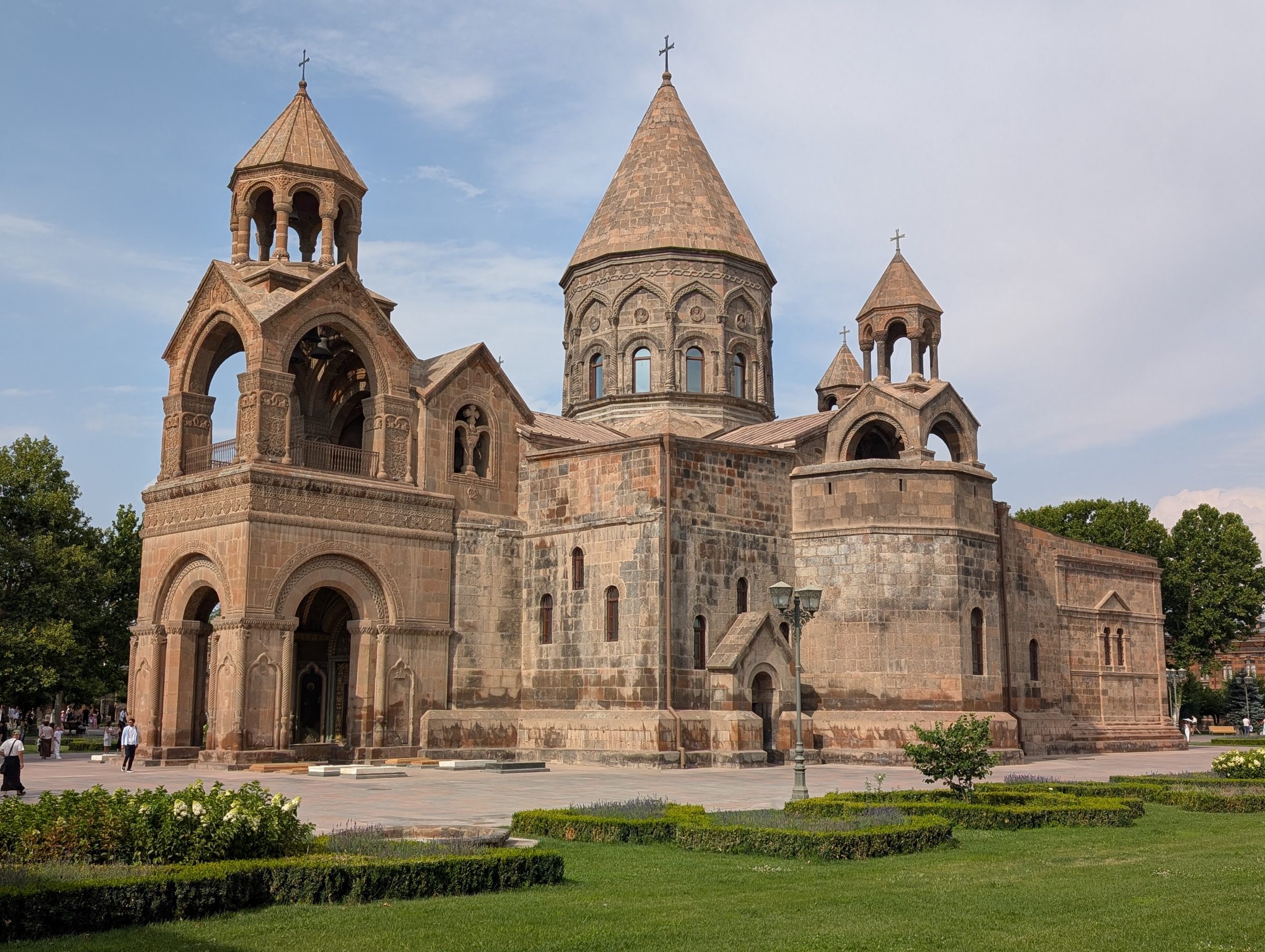 Photo: Yerevantsi, CC BY 4.0
The tentative list: eight entries
Armenia has eight entries on the tentative list; they are in the table below. The current list is on the UNESCO website.
Year submitted
- Dvin, archaeological site
- 1995
- Yeruyk
- 1995
- Noravank and the upper Amaghu valley
- 1995
- Monasteries of Tatev and Tatevi Anapat with the Vorotan valley
- 1995
- Vishaps and the cultural landscape of Tiringatar
- 2024
- Garni archaeological complex and the Symphony of Stones
- 2025
- Urartian heritage of Yerevan
- 2025
- Areni-1 cave (“Bird Cave”): prehistoric life and winemaking in the Arpa gorge
- 2026
BarevTrip catalog stop
- Dvin, archaeological site
- none
- Yeruyk
- none
- Noravank and the upper Amaghu valley
- Noravank Monastery
- Monasteries of Tatev and Tatevi Anapat with the Vorotan valley
- Tatev Monastery
- Vishaps and the cultural landscape of Tiringatar
- none
- Garni archaeological complex and the Symphony of Stones
- Garni Temple, Symphony of Stones gorge
- Urartian heritage of Yerevan
- —
- Areni-1 cave (“Bird Cave”): prehistoric life and winemaking in the Arpa gorge
- Areni-1 Bird Cave
Tour
- Dvin, archaeological site
- —
- Yeruyk
- —
- Noravank and the upper Amaghu valley
- Khor Virap, Areni & Noravank, Tatev Monastery & Wings of Tatev
- Monasteries of Tatev and Tatevi Anapat with the Vorotan valley
- Tatev Monastery & Wings of Tatev
- Vishaps and the cultural landscape of Tiringatar
- —
- Garni archaeological complex and the Symphony of Stones
- Garni Temple & Geghard Monastery
- Urartian heritage of Yerevan
- —
- Areni-1 cave (“Bird Cave”): prehistoric life and winemaking in the Arpa gorge
- Khor Virap, Areni & Noravank
Four of the eight entries are stops of the catalog: Noravank, Tatev, Garni and Areni-1. Khor Virap, Sevanavank, Haghartsin, Goshavank, Odzun and Amberd are not on the List. That is a status, not a judgment of the place. On Garni — Garni Temple: hours, tickets and how to get there from Yerevan; on choosing between Garni and Khor Virap for one short outing — Garni or Khor Virap: what to choose with one day in Yerevan.

Intangible heritage: a separate list
The separate Representative List of the Intangible Cultural Heritage has nothing to do with buildings; Armenia has eight elements on it: the duduk (2008), the art of khachkars (2010), the epic “David of Sassoun” (2012), lavash (2014), the kochari dance (2017), the art of Armenian letters (2019), the pilgrimage to the Monastery of the Holy Apostle Thaddeus (2020, with Iran), and the blacksmithing of Gyumri (2023). Two nominations — “Tirgan/Vardavar” (with Iran) and “winemaking of the Areni community” — await the decision of the session of 30 November – 5 December 2026 in Xiamen. Lavash baking is a separate stop on the tour Garni, Geghard & Lavash Baking.
Hours and tickets
The monasteries of the Armenian Apostolic Church have no official schedule: one is published only for the museums of the Mother See. Entrance tickets are not included in the price of the trip — they are bought on site, separately; it is safer to have cash in drams. The sums in the table are the institutions’ prices, paid on site.
Hours
- Geghard Monastery
- no official schedule; open in the daytime
- Monasteries of Haghpat and Sanahin
- no official schedule; open in the daytime
- Etchmiadzin Cathedral, Hripsime, Gayane
- no official schedule; at weekends during the liturgy you cannot always get into the cathedral
- Museums of the Mother See: the treasury, the Ruben Sevak museum
- Tuesday – Sunday 10:30–17:30
- Zvartnots Temple ruins
- daily 10:00–18:00, Sunday until 16:00
- Garni Temple (tentative list)
- 10:00–21:30; in winter the temple closes earlier
- Symphony of Stones gorge
- —
Entry
- Geghard Monastery
- free
- Monasteries of Haghpat and Sanahin
- free
- Etchmiadzin Cathedral, Hripsime, Gayane
- free
- Museums of the Mother See: the treasury, the Ruben Sevak museum
- treasury — 2,000 AMD for foreigners, Ruben Sevak museum — 500 AMD (the institution’s price, paid on site)
- Zvartnots Temple ruins
- 1,500 AMD, reduced ticket 750 AMD (the institution’s price, paid on site); children under 12 free
- Garni Temple (tentative list)
- 1,500 AMD, reduced ticket 750 AMD (the institution’s price, paid on site); children under 12 free
- Symphony of Stones gorge
- paid, pay at the ticket office
The hours and entry of Areni-1, Noravank and Tatev are not in the table: these places are not on the UNESCO List.
How to see them in a day: three directions
The three sites of the List lie in three directions from Yerevan, and the catalog gathers them into three trips. The price is per car, sedan or minivan; pickup at your hotel or address at the time you choose, 09:00 by default.
Tour
Hours · km
- East
- 5 h · 80 km
- West
- 6 h · 120 km
- North
- 10 h · 380 km
What is UNESCO
- East
- Geghard (no. 960); Garni and the Symphony of Stones — tentative list
- West
- all of no. 1011: the cathedral, Hripsime, Gayane, Zvartnots
- North
- no. 777 bis; Odzun and Akhtala are not UNESCO
Minutes on site per the catalog
- East
- Geghard 60, Garni 60, Symphony of Stones 45, Charents Arch 15
- West
- Zvartnots 40, Echmiadzin with Hripsime and Gayane 90, Khor Virap 60
- North
- Sanahin 60, Haghpat 60, Odzun 30, Akhtala on request 40
Price per car
- East
- 30,000 / 44,000 AMD
- West
- 39,000 / 55,000 AMD
- North
- 64,000 / 88,000 AMD
The west is also available in a longer version with Sardarapat: Echmiadzin, Sardarapat & Zvartnots, 8 h · 130 km, the price is on the trip page. All three sites in one day do not work out in the catalog: the three trips add up to 21 hours, and the north alone takes 10 hours because of the road to Lori and back. A two-day plan — east and west on the first day, north on the second. Geghard, Etchmiadzin and Zvartnots in one day are not in the catalog; request such a day through a custom route — a quote within two hours, around the clock, it is a request, not a booking. On cancellation and the driver’s language — how it works. Related answers: what to combine in one day from Yerevan, how many days you need for day trips from Yerevan, Garni and Geghard on your own or with a driver, a private driver, a group tour or a rental car.
When to go and what to allow for
Fact
- Daylight in winter
- on 21 December in Yerevan sunrise 08:20, sunset 17:39
- Zvartnots on Sundays
- the museum works until 16:00
- Museums of the Mother See
- Tuesday – Sunday; on Monday, by the hours, they are closed
- Symphony of Stones in winter
- per the catalog, the descent may be closed after heavy snow
- Haghpat and Sanahin in winter
- the monasteries are open-air, the stone is slippery after rain
What to do
- Daylight in winter
- the northern tour with a 09:00 pickup ends around 19:00, and the last hour to hour and a half is in the dark; in winter set an earlier pickup for Lori (the time is set in the form); more — where to go from Yerevan in winter
- Zvartnots on Sundays
- put Zvartnots first, as in the catalog tour
- Museums of the Mother See
- the cathedral is open, the treasury is not; at weekends during the liturgy you cannot always get into the cathedral
- Symphony of Stones in winter
- Garni and Geghard stay accessible
- Haghpat and Sanahin in winter
- wear shoes with a non-slip sole; check the weather and the road to Lori before leaving
By tradition
UNESCO and ICOMOS themselves mark these stories as tradition; the dates of the buildings are above.
- By tradition, Geghard was founded in the 4th century by Gregory the Illuminator; the earliest surviving inscriptions are of 1177 and 1181.
- By church tradition, the spear that pierced Christ was brought to Armenia by the Apostle Thaddeus; the monastery took its name, “the monastery of the spear”, from it. In the second half of the 18th century the spear was moved to Etchmiadzin; today it is there, not at Geghard.
- According to Agathangelos, a 5th-century historian, Christ appeared to Gregory the Illuminator and struck the ground with a golden hammer; a church was built on that spot — Etchmiadzin, “the Only-Begotten descended”.
- By church tradition, the first church was built in 301–303, right after the adoption of Christianity; the present appearance is the result of rebuildings from the 480s.
- By tradition, the church of Shoghakat of 1694 stands on the site of a 4th-century chapel where a ray of light fell on the martyrs of Hripsime.
What to check on site
- The monasteries’ hours. Geghard, Haghpat, Sanahin, the cathedral, Hripsime and Gayane publish no official schedule: ask the dispatcher about the opening time and the winter schedule when you order.
- Garni’s hours. In winter the temple closes earlier than the museum’s site shows: call the museum the day before.
- Payment at the ticket office. Take cash in drams: it is the safest way to pay at the museums and monasteries.
- The tentative list. The outcome of the nominations “Tirgan/Vardavar” and “winemaking of the Areni community” will be known after the session of 30 November – 5 December 2026.
- Dates of the buildings. Sources differ by a few years on some dates; the article gives the dates of UNESCO and ICOMOS.
Questions about this trip
Do I need a guide to visit the UNESCO sites?
How should I dress for the monasteries?
We are travelling with a child — what about the car seat and tickets?
Can I see all three sites in one day?
Ask AI about this trip
Opens in the service you choose, with a ready question about the article
Routes from this article


Sources and date of check
- UNESCO, open data whc001 “World Heritage List” (CC BY-SA 4.0): Armenia’s records, Statement of OUV texts, areas, components; dataset updated 2026-11-02 · checked November 6, 2026 · sections 2, 3, 8
- Operational Guidelines for the Implementation of the World Heritage Convention, WHC.13/01, July 2013 (PDF): paras 49, 62–68, 77 · checked November 6, 2026 · section 1
- UNESCO, intangible cultural heritage: Armenia page (elements and pending nominations) · checked November 6, 2026 · section 4
- Mother See of Holy Etchmiadzin, museums: hours, phones and ticket prices (page with no update date) · checked November 6, 2026 · sections 5, 7
- Zvartnots museum-reserve, official website: hours, tickets, museum history (page with no update date) · checked November 6, 2026 · sections 2, 5, 7
- Garni museum-reserve, official website: hours and tickets (page with no update date) · checked November 6, 2026 · sections 5, 9
- BarevTrip catalog, GET /api/routes (meta.updated_at 2026-11-05) · checked November 6, 2026 · sections 3, 4, 5, 6, 7
More articles

