 BarevTrip


Grand South Loop: Khor Virap, Noravank, Tatev, Karahunj & Sevan
14 h · 600 km · hotel to hotel · South: Ararat, Vayots Dzor, Syunik| Sedanup to 3 with 3 suitcases or 4 with 2 | 105,000 AMD |
|---|---|
| Minivanup to 7 | 130,000 AMD |
Tour request
Step 1 of 2Included, not included, extrasEntrance tickets are separate
- Car with driver for the whole route, hotel to hotel
- Stops as per programme, waiting at each
- Free child seat
Free cancellation and one free reschedule up to 24 hours before pickup, Yerevan time. No deposit: nothing to pay before confirmation.
Contacts next; payment only after confirmation
Stops in order
14 h total- Hotel in YerevanPick-up at your address at the chosen time09:00
- © BarevTrip
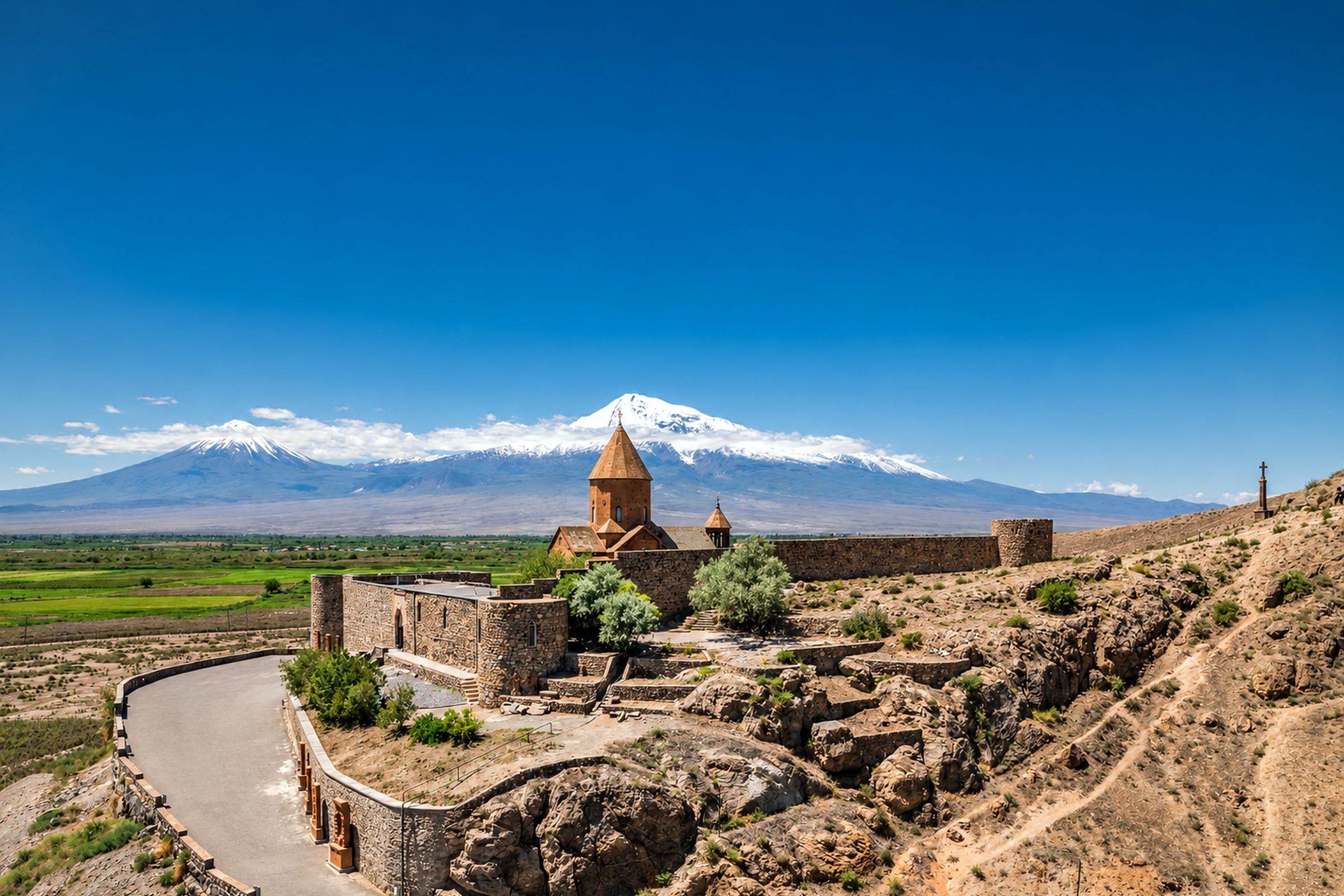
Khor Virap is a working monastery on a rocky hill in the Ararat Valley, close to the Turkish border, with Mount Ararat rising directly opposite. According to church tradition, Gregory the Illuminator was held here in an underground dungeon for thirteen years. Most of today's buildings date from the 17th century: a wall with round towers, the Church of the Holy Mother of God and a chapel where a narrow iron ladder leads down into a pit about six metres deep. The surrounding hills hold the ruins of Artashat, an ancient Armenian capital.
Free entry
Noravank is a 12th–14th century monastery in the narrow gorge of the Gnishik River, beneath sheer red cliffs. In the 13th and 14th centuries it was the seat of the metropolitans of Syunik and the burial place of the Orbelian princes. Its best-known building is the two-storey Surb Astvatsatsin church of 1339, with narrow steps running straight up the facade to the upper chapel. Next to it stands the 13th-century main church, whose narthex keeps carved tympana and tombstones.
Free entry
Shaki is a waterfall about 18 metres high in Syunik, a few kilometres from Sisian. Here the short Shaki stream, a left tributary of the Vorotan, drops into a gorge from a broad ledge of dark volcanic rock in many separate strands, with trees growing along the rim. A small hydropower plant shares the stream's water with the falls, so the flow varies noticeably from hour to hour and day to day. A path of about 300 metres leads from the roadside car park to the foot of the falls.
Tatev, a working monastery, stands on a rocky promontory above the Vorotan Gorge in southern Armenia. Its main church, dedicated to Saints Peter and Paul, was built in 895–906, and fragments of 10th-century wall paintings survive on its walls. In the 14th and 15th centuries the monastery was home to a university. Within the fortified wall stand churches from the 11th to 13th centuries, living quarters and the Gavazan, an octagonal stone column that can sway. The Wings of Tatev cable car runs across the gorge to the monastery from the village of Halidzor.
Free entry
Zorats Karer, also known as Karahunj, is a field of prehistoric stones on a plateau near Sisian, about 1770 m above sea level. More than two hundred basalt blocks up to three metres tall form a ring around a stone mound over a tomb, with long rows running out from it. Some of the stones are pierced by round through-holes. Archaeologists regard the site as a Bronze and Iron Age necropolis, while the idea of an ancient observatory remains disputed.
Ticket: pay separately on site
Selim Caravanserai, a stone shelter for merchants and their pack animals, stands on the southern slope of the Selim (Vardenyats) Pass, about 2350 m above sea level. According to the Armenian inscription in its vestibule, Prince Chesar Orbelian built it with his family, and the work was completed in 1332. Inside is a dark three-aisled hall on seven pairs of pillars, with stone mangers and light openings in the vault. Above the entrance are reliefs of a bull and a winged beast.
Free entry
Sevan, the largest freshwater lake in the Caucasus, lies at about 1900 metres in Gegharkunik Province. An underwater sill divides it into Small Sevan and Big Sevan, and only one river, the Hrazdan, flows out of it. From 1933 its water was drained for irrigation and hydropower: the level fell by almost 20 metres, and by the 1950s the island with Sevanavank Monastery had joined the shore. At the foot of the peninsula there are pebble beaches and fish restaurants, and the lake with its shores forms Sevan National Park.
- Hotel in YerevanReturn to the same or another address in the city≈ 23:00


Driving between stops takes about 7.5 h. You can change the order by telling the driver.
What’s included, what’s not
- Included
- Car with a driver for the whole route, hotel to hotel
- Stops as planned and waiting at each one
- Free child seat
- Fuel, parking, water
- Not included
- Entrance tickets: paid on the spot
- Lunch: per the café menu
- Qualified guide: optional, + 80,000 AMD
- Tips at your discretion
One surcharge: an unplanned stop or a change of route.
 5.0
 5.0

